


A while back I went down the rabbit hole of learning about systems thinking. And once you start looking at organizations through that lens, it becomes difficult to unsee.
The best organizations I’ve interacted with seem to have been intentionally built this way. Decisions happen without escalation. Information travels to where it is needed. People understand what matters. Problems get surfaced and solved without waiting for someone senior enough to notice them.
Great products require great leaders. But great organizations? I’m beginning to think they’re built on great systems. And perhaps the mark of a great system is how little intervention it eventually requires from the person who created it.
Thinking in systems
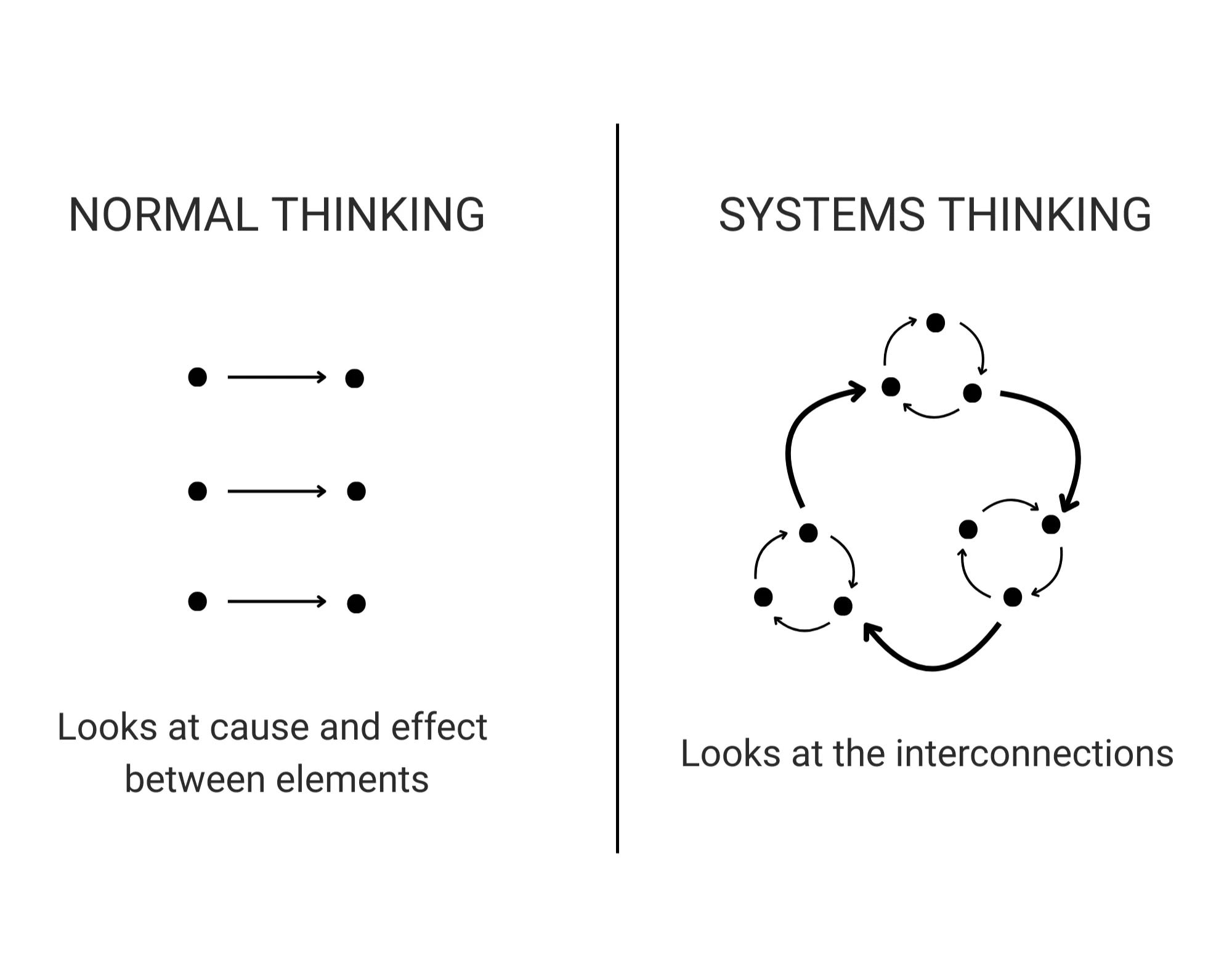
Most of us naturally think in cause and effect. I’m hungry, so I eat. Sales are down, so we hire more salespeople. A team is underperforming, so we change the leader. For simple problems, this works remarkably well.
Organizations aren’t simple problems. They are interconnected networks of people, incentives, information, policies, culture, and emotion. Change one thing and something seemingly unrelated can change somewhere else.
Systems thinking asks us to stop looking only at individual events and start looking at the relationships between them.
Instead of asking: Why did this happen? You begin asking: What system keeps producing this outcome? That feels like a subtle distinction, but the results vary significantly.
Organizations are made up
It’s easy to forget that organizations are man-made. At least it is for me.
They don’t just exist. Someone decided how information should travel. Someone decided who can approve what. Someone designed the incentives. Someone created the meeting. Someone hired the first ten people who eventually defined what “normal” looked like.
Some of those decisions were intentional. Many probably weren’t. Over time, they compound into something we call the organization. How you build that organization is a choice.
My biased pattern recognition is that operators building for the first time tend to build differently from operators building for the second time. The clearest difference I’ve noticed is in their relationship with feedback loops.
A feedback loop is simpler than it sounds. Something happens. The result becomes information. That information changes what happens next.
Imagine a customer complains about a delivery. In one company, the complaint reaches customer service. Someone apologizes. A refund is issued. The ticket closes.
In another company, that same complaint is categorized. Operations sees the pattern. The delivery process changes. Future complaints decline.
Same complaint. Different system. The first company solved an event. The second improved the system. That distinction compounds and a well-designed feedback loop reduces the distance between an outcome, the information it creates, and the people capable of acting on it.
Eventually the organization begins correcting itself. That’s where things get interesting.
Systems are still human
There is something slightly uncomfortable about talking about organizations as machines. They’re not. Humans make up organizations, and we are emotional. We respond to incentives. We protect our status. We avoid difficult conversations. We interpret the same information differently.
Perhaps the objective of a great system isn’t to eliminate irrational human behavior. It’s to design with it in mind. The best systems accept human nature and gently push it toward better outcomes.
Can we really design one system for an entire organization when everyone inside it has different incentives? I don’t know. But there are three things I’ve increasingly come to believe matter.
1. Make the information that matters public by default
Information itself is a feedback loop. The shorter the distance between reality and the people making decisions, the faster an organization can respond. Shared information creates shared context. And shared context allows people to make good decisions without asking permission.
This can be as simple as keeping key information on public channels on Slack instead of on private chats or emails.
2. Know what drives the company
Every organization seems to have a dominant function. Sometimes it’s product. Sometimes growth. Sometimes operations. Sometimes finance. It can and probably should change as the company evolves.
But just as most of us have a dominant hand, I think great organizations usually have a clear dominant decision driver. I’m happy to be proven wrong, but I’ve yet to see a great company without one.
When trade offs appear, everyone in the room needs to understand what wins.
3. Let people solve problems with each other
Organizations naturally create hierarchies, however, information shouldn’t necessarily follow them.
Innovation and problem-solving often emerge horizontally from people with different information finding each other not vertically through directives from the top. I experienced this long before I understood the theory.
One of the best projects I worked on early in my career at Kimberly-Clark wasn’t really my idea. I discovered something the Brazil team had already built, adapted it to our market, and my peers across the globe couldn’t have been more supportive.
The system allowed knowledge to travel sideways. I just happened to be one of its beneficiaries.
What about the board?
Before moving to the dark side of investment and asset management, I held a belief that one of the primary roles of a board was to build the systems that allow a company to succeed. I don’t anymore. That view was probably formed by my exposure to family businesses, where ownership is often much more directly represented at the board table.
Today, I think the responsibility sits much more clearly with the leaders and operators inside the organization. They design the system. They operate within it. And they’re responsible for improving it. That’s ultimately part of what you’re betting on when you invest in a management team.

Expecting a board to build the operating system of a company feels a little like trying to steer a boat from the lighthouse. The lighthouse can show you where the rocks are. It can help you understand where you’re going. But someone still needs to captain the boat.
Of course, all of this sounds wonderfully clean and sensible written behind a computer. Running a fast-growing company isn’t anything like that. It’s closer to learning how to drive a bus while the bus is already moving. And occasionally changing a tire at the same time.
Customers need answers today. People need hiring. Cash needs managing. Products need shipping. Telling a founder dealing with all of that to “design better feedback loops” is admittedly a big ask. Putting out the fire is usually faster than designing a system that prevents the next one.
But I suspect this is precisely where great operators and organizations separate themselves. They solve today’s problem while slowly building a system that makes tomorrow’s version less dependent on them.
Do that enough times and something begins to compound. Information moves faster. People make better decisions. Problems correct themselves earlier. The organization develops its own momentum. The flywheel starts moving faster than any individual could push it.
Which brings me back to a question that has been lingering in my mind.
Can the best organizations excel without a leader?
I think they can excel without constantly needing one. That’s an important distinction.
Great leaders don’t make themselves irrelevant. They build organizations that don’t require their presence in every decision. The system handles what it already knows how to handle. People have the information, incentives, empowerment, and accountability to act.
And leadership becomes most valuable when the system encounters something it wasn’t designed for. A black swan event, a change in technology, or a change in culture.
In my view, the leader who builds companies that compound asks: How do I design an environment where people consistently make good decisions without me? Perhaps that’s the paradox. The better you become at leading an organization, the less the organization should need you to lead every part of it.
And maybe that’s the game great leaders thrive playing.
In product, it is very easy to optimize for the short term outcome, ship the change, and move on.
But I believe the mature approach here is asking:
Why did this require intervention in the first place, and how do we make the next issue less dependent on someone noticing it?
I think that’s where systems thinking becomes powerful; it isn’t to eliminate problems, but to shorten the distance between a problems appearing, learning from it, and the system adapting to it.
from my own experience i 100% agree i’ve always known i needed better systems but never really knew how to think about building them this gave me a much clearer way to look at it thank you for sharing this reflection Moayed